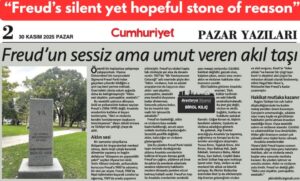


Freuds stiller, aber hoffnungsvoller Stein der Vernunft in Wien und der Türkei
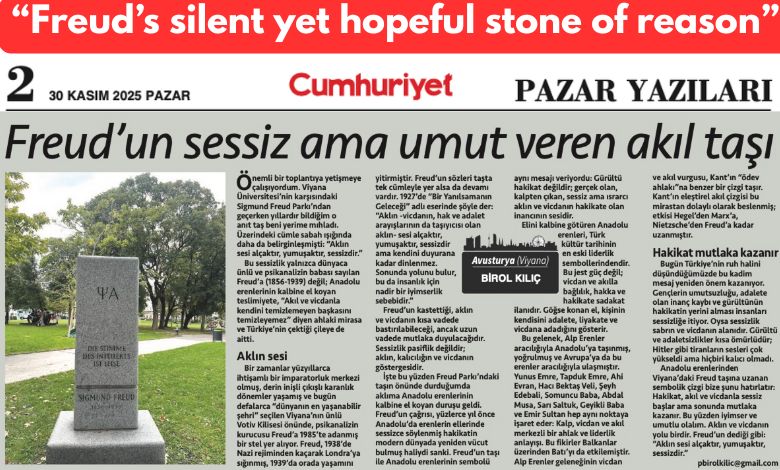
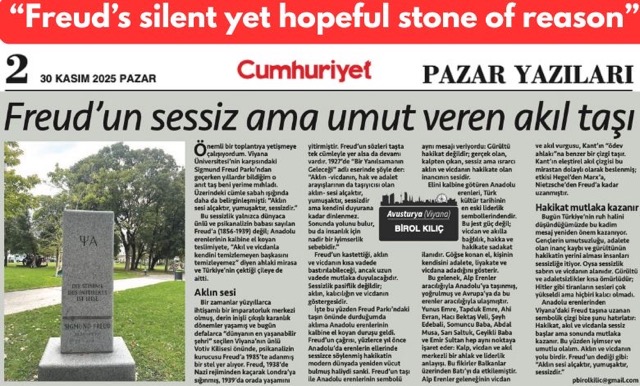
On 30 October 2025, the traditional Turkish quality newspaper Cumhuriyet (“The Republic”), the oldest newspaper still in circulation in Turkey, published an essay by Birol Kiliç from Vienna entitled “Freud’s quiet but hopeful stone of reason in Vienna and Turkey” in its section for prominent authors on page two. The article has been translated into both German(first) and English. Kiliç is the founder and editor of the newspapers Neue Heimat Zeitung, Türkische Allgemeine, and Neue Welt Verlag in Vienna.
Freuds stiller, aber hoffnungsvoller Stein der Vernunft in Wien und der Türkei
Cumhuriyet, Birol Kiliç, Seite 2, 30.11.2025
Es war einer jener Novembermorgen, an denen die Kälte Wiens wie ein feiner Schnitt auf der Haut liegt, und ich versuchte, rechtzeitig zu einer wichtigen Besprechung zu gelangen. Als ich durch den Sigmund-Freud-Park gegenüber der Universität Wien ging, hielt mich plötzlich jener Gedenkstein fest, den ich seit Jahren kenne, aber offenbar noch nie wirklich betrachtet hatte.
Im Morgenlicht erschien die Inschrift darauf schärfer, klarer und eindringlicher: „Die Stimme der Vernunft ist leise, sanft und still.“
Diese Stille gehörte nicht nur dem weltberühmten Freud (1856–1939), dem Vater der Psychoanalyse, sondern auch jener Hingabe, die das Herz der Anatolier erfasst – jenem moralischen Erbe, das sagt: „Wer sich nicht mit Vernunft und Gewissen reinigt, kann andere nicht reinigen.“ Ebenso gehört diese Stille dem Leiden der Türkei, in der Rechtsstaat, Meinungsvielfalt, Pressefreiheit, Gewaltenteilung und die freiheitlich-demokratische Grundordnung auf der Intensivstation liegen.
Wenn wir heute über die seelische Lage der Türkei nachdenken, gewinnt diese alte Botschaft neue Bedeutung. Die Hoffnungslosigkeit der Jugend, der Verlust des Glaubens an Gerechtigkeit und die Verdrängung der Wahrheit durch Lärm treiben die Menschen in die Stille. Doch Stille ist der Raum von Geduld und Gewissen.
Lärm und Ungerechtigkeit sind kurzlebig. Die Stimmen von Tyrannen wie Hitler waren sehr laut, aber keine von ihnen hat Bestand.
Die symbolische Linie von den anatolischen Erenler bis zum Freud-Stein in Wien erinnert uns daran: Wahrheit beginnt leise mit Vernunft und Gewissen, doch am Ende siegt sie immer.
Der Weg der Vernunft und des Gewissens der Menschheit, der aus der Vergangenheit lernt, ist derselbe. Wie Freud sagte: „Die Stimme der Vernunft ist leise, sanft und still.“ Die Vernunft und die Rechtschaffenen werden siegen. Ohne Zweifel.
Die Stimme der Vernunft und ein Optimist?
Vor der berühmten Votivkirche in Wien, einer Stadt, die jahrhundertelang das Zentrum eines glanzvollen Reiches war, dunkle Zeiten überstand und heute mehrfach zur „lebenswertesten Stadt der Welt“ gewählt wurde, steht seit 1985 eine Stele, die Sigmund Freud gewidmet ist.
Freud floh 1938 vor dem NS-Regime nach London, wo er 1939 voller Kummer und Schmerzen starb, während seine vier Geschwister, die ihm de facto das Leben gerettet hatten, in NS-Konzentrationslagern starben.
Auf dem Stein ist nur ein einziger Satz zu lesen, der jedoch eine tiefere Fortsetzung hat. In seinem Werk „Die Zukunft einer Illusion“ (1927) schreibt Freud: „Die Stimme der Vernunft – zugleich Trägerin von Gewissen, Recht und Gerechtigkeit – ist leise, sanft, still, aber sie ruht nicht, bis sie gehört wird. Am Ende findet sie ihren Weg, und das ist ein seltener Grund für Optimismus für die Menschheit.“
Meinte Freud damit, dass Vernunft, Rechtschaffenheit, Ethik, Gewissenhaftigkeit und moralische Haltung zwar kurzfristig unterdrückt werden können, aber langfristig unvermeidlich Gehör finden? Demnach ist Stille kein Rückzug, sondern Ausdruck von Beständigkeit und moralischer Beharrlichkeit.
Als ich vor dem Stein stand, erinnerte ich mich an die Haltung der anatolischen Erenler, die ihre Hand auf das Herz legen und die gleiche Botschaft „Hand aufs Herz“ vermitteln. Und trotzdem gibt es in der Türkei unvernünftige und herzlose Entwicklungen, wenn der Staat de facto ausgebeutet wird. Freuds Botschaft schien wie eine moderne Wiedergeburt jener Wahrheit, die die Erenler schon vor Jahrhunderten still verkündet hatten.
Freuds Stein und das Symbol der anatolischen Erenler vermitteln dieselbe Botschaft. Lärm ist nicht gleichbedeutend mit Wahrheit; wahr ist die Stimme der Vernunft und des Gewissens, die still, aber beharrlich an die Wahrheit glaubt.
Die Hand auf dem Herzen ist eines der ältesten Führungszeichen der türkischen Kulturgeschichte. Mit dieser Geste wird keine Macht verkündet, sondern Treue zu Gewissen und Vernunft sowie Loyalität zu Recht und Wahrheit. Durch die Alp Erenler gelangte diese Tradition nach Anatolien, wurde dort geprägt und erreichte schließlich auch Europa über die Erenler.
Yunus Emre, Tapduk Emre, Ahi Evran, Hacı Bektaş Veli, Şeyh Edebali, Somuncu Baba, Abdal Musa, Sarı Saltuk, Geyikli Baba und Emir Sultan weisen alle auf denselben Punkt hin. Sie alle vertreten eine Moral- und Führungsauffassung, die Herz, Gewissen und Vernunft ins Zentrum stellt. Diese Ideen beeinflussten über die Balkanregion hinweg auch das westliche Denken.
Der kategorische Imperativ, ein unbedingtes Gebot der Vernunft, ist das Kernstück von Kants „Pflichtenethik“. Kants kritische Vernunft wurde indirekt von diesem Erbe genährt, und sein Einfluss reicht von Hegel bis zu Freud. Er ermutigt uns, optimistisch und hoffnungsvoll den moralischen Weg nicht zu bezweifeln – den Weg von Vernunft und Gewissen.
Wie Freud sagte: „Die Stimme der Vernunft ist leise, sanft und still.“ Die Vernunft und die Rechtschaffenen werden siegen“
Ohne Zweifel….
Quelle:
https://www.cumhuriyet.com.tr/pazar-yazilari/freud-un-sessiz-ama-umut-veren-akil-tasi-2457079
Englisch
Freud’s silent yet hopeful stone of reason
Cumhuriyet, 30.11.2025, S.2, Birol Kiliç, Vienna
It was one of those November mornings when the cold of Vienna lay on the skin like a fine cut, and I tried to get to an important meeting on time. As I walked through the Sigmund Freud Park opposite the University of Vienna, I was suddenly held by that memorial stone which I had known for years, but apparently had never really looked at.
In the morning light the inscription on it appeared sharper, clearer, more compelling: “The voice of reason is quiet, gentle and still.”
This silence belonged not only to the world‑famous Freud (1856–1939), the father of psychoanalysis, but also to that devotion which captures the heart of the Anatolians – that moral heritage which says: “Whoever does not cleanse himself with reason and conscience cannot cleanse others.” Likewise, this silence belongs to the suffering of Turkey, where the rule of law, diversity of opinion, freedom of the press, separation of powers and the liberal‑democratic order lie in intensive care.
When we think today about the spiritual condition of Turkey, this old message gains new meaning. The hopelessness of the youth, the loss of faith in justice and the displacement of truth by noise drive people into silence. Yet silence is the space of patience and conscience.
Noise and injustice are short‑lived. The voices of tyrants like Hitler were very loud, but none of them endured.
The symbolic line from the Anatolian Erenler to the Freud stone in Vienna reminds us: truth begins quietly with reason and conscience, yet in the end it always triumphs.
The path of reason and conscience of humanity, which learns from the past, is the same. As Freud said: “The voice of reason is quiet, gentle and still.” Reason and the righteous will prevail. Without doubt.
The voice of reason and an optimist?
In front of the famous Votive Church in Vienna, a city that for centuries was the center of a splendid empire, survived dark times and today has been chosen several times as the “most livable city in the world,” there has stood since 1985 a stele dedicated to Sigmund Freud.
Freud fled in 1938 from the Nazi regime to London, where he died in 1939 full of sorrow and pain, while his four siblings, who had in fact saved his life, perished in Nazi concentration camps.
On the stone only a single sentence is written, but it has a deeper continuation. In his work “The Future of an Illusion” (1927) Freud writes:
“The voice of reason – at the same time bearer of conscience, law and justice – is quiet, gentle, still, but it does not rest until it is heard. In the end it finds its way, and that is a rare reason for optimism for humanity.”
Did Freud mean that reason, righteousness, ethics, conscientiousness and moral attitude can be suppressed in the short term, but in the long term inevitably find a hearing? Silence is therefore not retreat, but expression of persistence and moral tenacity.
As I stood before the stone, I remembered the attitude of the Anatolian Erenler, who place their hand on the heart and convey the same message “hand on heart.” And yet there are in Turkey such unreasonable and heartless developments when the state is de facto exploited. Freud’s message seemed like a modern rebirth of that truth which the Erenler had already proclaimed silently centuries ago.
Freud’s stone and the symbol of the Anatolian Erenler convey the same message. Noise is not truth; true is the voice of reason and conscience, which quietly but persistently believes in truth.
The hand on the heart is one of the oldest signs of leadership in Turkish cultural history. With this gesture no power is proclaimed, but loyalty to conscience and reason as well as fidelity to law and truth. Through the Alp Erenler this tradition came to Anatolia, was shaped there and finally reached Europe through the Erenler.
Yunus Emre, Tapduk Emre, Ahi Evran, Hacı Bektaş Veli, Şeyh Edebali, Somuncu Baba, Abdal Musa, Sarı Saltuk, Geyikli Baba and Emir Sultan all point to the same truth. They all represent a moral and leadership concept that places heart, conscience and reason at the center. These ideas influenced Western thought across the Balkan region.
The categorical imperative, an unconditional command of reason, is the core of Kant’s “ethics of duty.” Kant’s critical reason was indirectly nourished by this heritage, and his influence extends from Hegel to Freud. He encourages us to remain optimistic and hopeful, not to doubt the moral path – the path of reason and conscience.
As Freud said: “The voice of reason is quiet, gentle and still.” Reason and the righteous will prevail. Without doubt.
Source:
https://www.cumhuriyet.com.tr/pazar-yazilari/freud-un-sessiz-ama-umut-veren-akil-tasi-2457079